Digital experiences designed around real people and real workflows.
Websites, apps and internal tools built to do something.
Plenty of software looks finished and solves nothing. It usually happens the same way: the brief described screens rather than the job someone was trying to get done.
We build websites, applications and internal tools starting from the work — who uses this, what are they trying to finish, and what currently makes that slow.
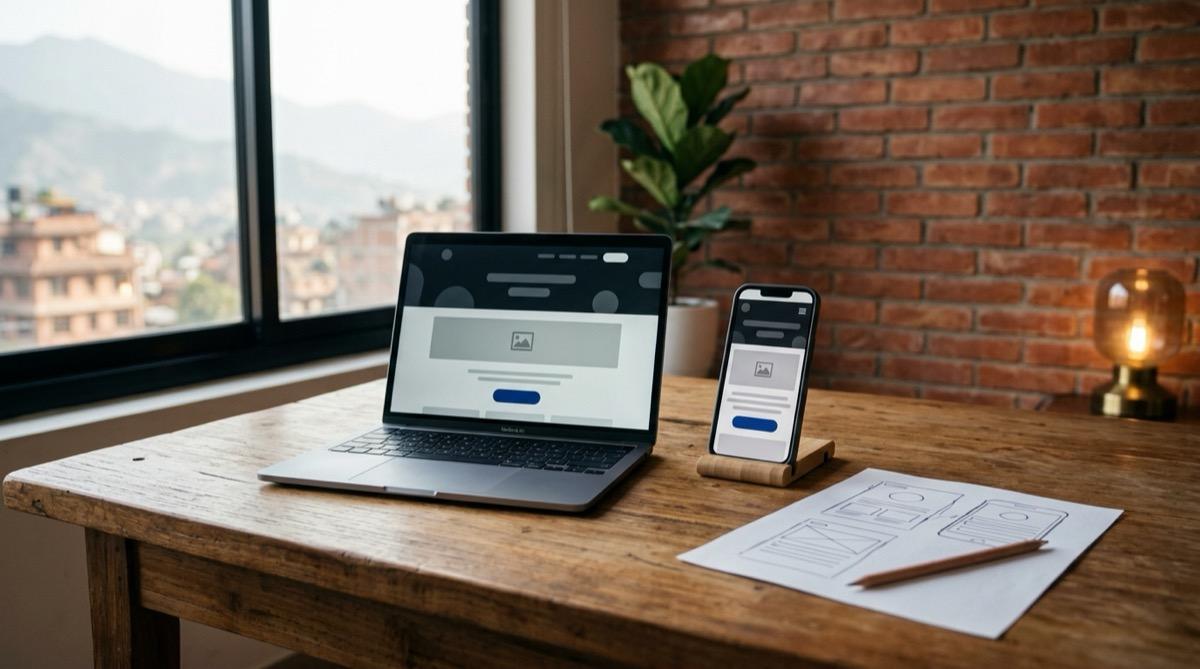
The internal tools nobody photographs
Some of the most valuable things we build are the least impressive to look at: the form that replaced a spreadsheet three people were editing at once, the dashboard that ended a weekly status meeting, the small system that turned a two-day reconciliation into an afternoon.
If a process in your business runs on a spreadsheet nobody fully trusts, that is usually a good place to start.
Built to be maintained
A website that cannot be updated without calling the people who made it is only half delivered.
We build on technology your team or any competent developer can pick up, we write down how it works, and we hand over the accounts and the code. It belongs to you.
That extends to the things that decide whether anyone finds the site at all — performance, structure, metadata and accessibility are part of building it, not an upsell afterwards.
Design that survives contact with content
A layout that only works with the perfect headline is not a design, it is a photograph of one.
We design with the real content, on the devices people actually hold, including the slow connection on the way home.
What’s included.
- Websites
- Marketing and brochure sites built to load fast, be found, and stay editable.
- Mobile apps
- Applications for the jobs that genuinely belong on a phone rather than a desk.
- Internal tools
- The unglamorous systems that remove repeated manual work from a team.
- UI/UX
- Interface and experience work grounded in what users are trying to finish.
- Design systems
- Consistent components so the fifth screen costs less than the first.
- Handover
- Code, accounts and documentation transferred to you at the end. No hostage-taking.
You probably need this if.
- A core process in your business runs on a spreadsheet several people edit.
- Your website cannot be updated without going back to whoever built it.
- The site is slow, or does not work properly on a phone.
- Two systems hold the same data and neither agrees with the other.
- You have an idea for an internal tool but no one to build it.
Questions.
Do we own the code and the accounts at the end?
Yes. Code, hosting, domains and documentation are transferred to you.
We do not believe in holding a business hostage to a contract through its own website.
Can you take over a project someone else built?
Often, yes. We start by reading what is there and telling you honestly whether it is worth continuing or worth replacing.
Both answers happen. We would rather say the unprofitable one than find out later.
Do you handle hosting and maintenance afterwards?
We can. Hosting, updates, backups and ongoing changes can be part of the arrangement, or you can take it in-house.
The documentation is written so that the second option is genuinely possible.
How long does a website take?
A straightforward marketing site is usually a few weeks; an application depends entirely on what it has to do.
You get a scope and a timeline before the work starts, and you hear about changes before they reach the invoice.
Often needed alongside
Tell us what you’re working with.
We’ll take a look and tell you what makes sense from there. The walkthrough comes before the proposal, and the scope comes before the work.
Request a quote